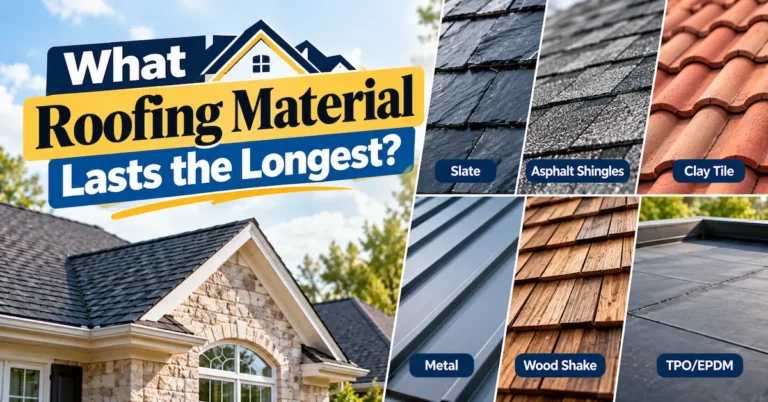
If you’re asking what roofing material lasts the longest, the short answer is natural slate, which can last well over a century when properly installed and maintained. But slate isn’t the right fit for every home or budget, and several other materials offer strong durability at a fraction of the cost and weight. Understanding how each option compares makes it much easier to choose the right roof for your home rather than just the cheapest one upfront.
Here’s how the most common roofing materials stack up, and what actually determines how long each one lasts in practice.
Roofing Material Lifespan Comparison at a Glance
| Material | Typical Lifespan |
|---|---|
| 3-tab asphalt shingles | 15 to 20 years |
| Architectural asphalt shingles | 25 to 30 years |
| Wood shake or shingles | 20 to 40 years |
| Synthetic or composite shingles | 40 to 60 years |
| Metal panels | 30 to 50 years |
| Standing seam metal | 40 to 70 years |
| Concrete tile | 40 to 75 years |
| Clay tile | 50 to 100 years |
| Natural slate | 75 to 150 years |
| Flat membrane (TPO or EPDM) | 15 to 30 years |
These ranges assume professional installation, reasonable maintenance, and a moderate climate. Extreme heat, humidity, hail exposure, or poor ventilation can push any material toward the shorter end of its range, which is worth keeping in mind for a climate like Sugar Land’s.
What Roofing Material Lasts the Longest? Natural Slate Takes the Lead
Slate is the material most often cited as the longest lasting roofing option available, and for good reason. Made from natural stone, slate is resistant to fire, moisture, and general wear, and roofs installed generations ago are still performing well today. The tradeoff is significant weight, often requiring reinforced framing, a high upfront cost, and the need for specialized, experienced installers. Slate is a strong option for homeowners planning to stay long term and prioritizing longevity over upfront cost, but it’s a less common choice in hot, humid regions where the added structural requirements and cost are harder to justify.
Clay and Concrete Tile: Long Lasting and Climate Suited
Clay tile can last between 50 and 100 years, while concrete tile typically falls in the 40 to 75 year range. Both materials resist fire, insects, and rot, and their light color options reflect heat well, which is a genuine advantage in a hot climate. Like slate, tile is heavy and often requires additional structural support, and proper installation matters significantly for long term performance in areas with heavy rainfall.
Metal Roofing: A Strong Middle Ground
Standing seam metal roofing can last 40 to 70 years, while metal panel systems typically run 30 to 50 years. Metal resists wind, fire, and hail better than most other common materials, and its lighter weight compared to tile or slate means it doesn’t usually require the same structural reinforcement. Metal roofing has become increasingly popular in storm prone regions specifically because of this combination of durability and lighter weight, though the exposed fasteners on some panel systems need periodic inspection since their seals can degrade with age.
Synthetic and Composite Shingles
Synthetic or composite shingles, designed to mimic the look of slate or wood shake, typically last 40 to 60 years. They’re significantly lighter than natural slate or tile, which avoids the structural concerns those materials carry, while still offering a meaningfully longer lifespan than standard asphalt shingles. This makes them a middle ground option for homeowners who want a premium appearance without the weight or cost of natural materials.
Wood Shake and Shingles
Wood shake and wood shingles generally last 20 to 40 years depending on the wood type, local climate, and maintenance. Wood requires more upkeep than most other options, particularly in humid climates where moisture exposure can accelerate rot and encourage moss growth. It’s a less common choice in Gulf Coast regions for exactly this reason.
Asphalt Shingles: The Most Common Choice
Asphalt shingles remain the most widely used roofing material in the United States, largely because of their lower upfront cost and straightforward installation. Standard 3-tab shingles typically last 15 to 20 years, while architectural, or dimensional, shingles generally reach 25 to 30 years thanks to their thicker, multi-layer construction. In a hot, humid climate, asphalt shingles tend to land on the shorter end of these ranges unless the roof has proper attic ventilation and receives regular maintenance. We’ve covered this in more detail in our post on how Sugar Land’s humid climate affects roof lifespan, including why heat and moisture accelerate wear on asphalt specifically.
Flat Roof Membranes: TPO and EPDM
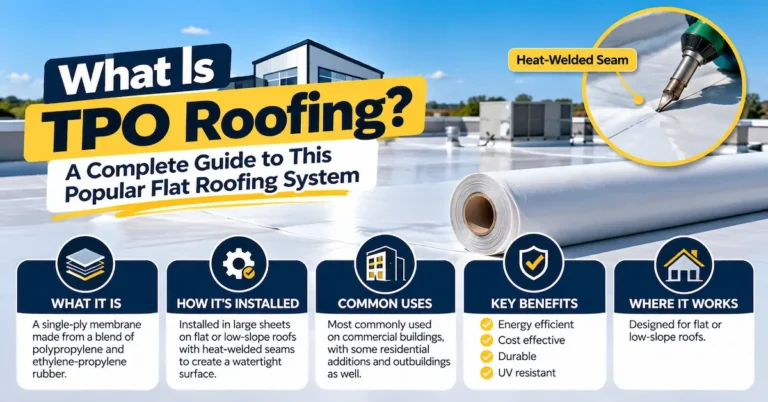
For flat or low-slope roofs, common on commercial buildings, TPO and EPDM membrane systems typically last 15 to 30 years. Lifespan depends heavily on membrane thickness, seam quality, and how well the roof drains, since standing water is one of the more common causes of premature failure on flat roofing systems.
What Actually Determines Whether a Material Reaches Its Full Lifespan
The numbers above are ranges, not guarantees, and several factors determine where a specific roof lands within them:
- Climate exposure. Intense UV, heat, and humidity accelerate wear on asphalt and wood in particular, while coastal salt spray can speed up corrosion on some metal panel systems.
- Installation quality. Even the most durable material underperforms if it’s installed incorrectly, with poor flashing, inadequate fastening, or insufficient overlap at seams.
- Attic ventilation. Trapped heat and moisture beneath the roof deck shorten the lifespan of nearly every roofing material, not just asphalt.
- Maintenance. Regular inspections and prompt repairs help any material reach the higher end of its expected range rather than the lower end.
This is one of the reasons the material itself is only part of the equation. A well maintained asphalt roof can outperform a poorly installed or neglected metal or tile roof, even though the material’s typical lifespan suggests otherwise.
Choosing the Right Material for Sugar Land’s Climate
For homeowners weighing these options locally, climate suitability matters as much as raw lifespan numbers. Materials that handle heat and humidity well, such as metal roofing, concrete or clay tile, and algae resistant architectural asphalt shingles, tend to perform more predictably here than materials better suited to drier or colder regions. We go into these tradeoffs, along with signs that indicate it may be time to consider a different material altogether, in our guide on when it’s time to replace your roof rather than repair it again.
If you’re weighing material options for an upcoming project, a roof replacement consultation can walk through which materials make sense for your specific home, budget, and how long you’re planning to stay in it.
The Bottom Line
Natural slate remains the longest lasting roofing material available, but it isn’t the practical choice for most homeowners once weight, cost, and structural requirements are factored in. Metal roofing, clay and concrete tile, and synthetic composites all offer a meaningful step up in durability over standard asphalt shingles without the same tradeoffs slate carries. The right choice ultimately depends on your budget, how long you plan to stay in the home, and how well the material suits your local climate.
FAQ
What roofing material lasts the longest overall?
Natural slate, which can last 75 to 150 years with proper installation and maintenance, is generally considered the longest lasting common roofing material.
Is metal roofing a good long term option in a hot, humid climate?
Yes. Metal roofing resists heat, wind, and moisture well, and its typical 30 to 70 year lifespan holds up reasonably consistently across different climates compared to materials like wood or standard asphalt.
Why don’t more homes use slate or tile if they last so much longer?
Cost and weight are the main reasons. Both materials require significant upfront investment and often need reinforced roof framing, which adds to the total project cost.
Do architectural shingles really last longer than 3-tab shingles?
Yes. Architectural shingles are thicker and use a multi-layer construction, which generally allows them to reach 25 to 30 years compared to 15 to 20 years for standard 3-tab shingles.
How much does a longer lasting roofing material cost compared to asphalt?
Cost varies significantly by material, roof size, and structural requirements. The most accurate way to compare options for your specific home is to get a quote from a connected local roofing professional.